
How are AFNs Neoliberal? What is the Context of Them in the City of Vancouver?
First let’s tackle this intimidating term neoliberalism. When broken down to its Latin roots it means new liberalism. But what does this mean? Depending on who you ask, you will get a slightly different answer (this is what I have learned with various concepts in my academic geography career so far). I particularly like how Dr. Geoff Mann defines it:
“The ongoing effort to construct a regulatory regime in which the movement of capital and goods across the globe is determined as much as possible by firms' short-term returns.
Because global geography is dynamic and uneven, neoliberalism is always incomplete. Thus neoliberalism is itself uneven, sometimes taking the form of deregulation (‘roll-back’), sometimes of reregulation (‘roll-out’). The state undertakes these regulatory endeavours via the increasing use of the nominally 'non-state' realm of 'the market' as a principal means of governance.” (Mann, 2014)
A more general definition is that because of decreased regulation and different forms of market governance, there is more freedom for the involved actors to practise upon what they wish (Logan and Molotch, 1987).
You may be thinking what does this have to do with alternative food networks. Good question! Here is a brief history about neoliberalism and growth of cities:
It all began from the Great Depression in 1930 or what economists also refer to as a “crisis of overproduction” (Hickel, 2012). John Maynard Keynes was an economist at the time and suggested that the state should regulate capitalism to ensure economic stability and social welfare. This led to a concept known as “embedded liberalism” where the state was involved in capitalism and was embedded in society. This economic model was promising throughout the 1950s and 60s but it hit a crisis of “stagflation” in the 1970s- mostly in the industrialized West. Stagflation is a combination of high inflation and economic stagnation.
Various economists suggested different reasons for this crisis. At the time the United States was particularly conservative and leaned towards the reason that the crisis is due to exhorbitant taxes on the wealthy and too much economic regulation which led to the end of embedded liberalism. David Harvey argues that the wealthy used this crisis to re-establish their dominance in social class as “the share of national income that went to the top 1% of earners fell from 16% to 8% during the post-war decades” (Hickel, 2012). This was okay if economic growth was strong, but it fell when stagflation detonated. They combatted this through the “Volcker Shock” which basically solved the issue by raising interest rates. However, this left many negative effects on the working class including unemployment and a huge recession.
During Reagan’s term as president, he introduced three policies that were vital in the success of neoliberalism- monetarist policy (targets low inflation), raising payroll taxes of the working class to reach “flat tax”, and deregulating the financial sector. I’m not going to get into detail with numbers and more confusing economic terms but it should be understood that these three components were and are key players in social inequality.
So far I’ve talked quite a bit about economics, where is the cultural geography? Don’t worry we’re getting there. Before that, I have to talk about the city as a ‘growth machine’ (Logan & Molotch, 1987).
Due to stagflation and the start of neoliberalism in the 1970s, federal governments decreased funding to local governments. Cities had to find new ways to promote themselves to attract investment (private or public) to avoid urban decay. Logan and Molotch (1987) describe this phenomenon as the ‘urban growth machine’. Key members of this machine or coalition are local actors including the mayor, businessmen, elites, and others who have interest in helping the city grow- mainly financially for more growth. An example of this at work is city slogans. I will use Glasgow as an example. During WWII Glasgow supplied a lot to the war efforts which resulted in heavy industries and busy shipyards. However, post-war there was deindustrialization and ultimately ensued in economic decline. Several coal mines, steelworks, engine factories, and other heavy industries went out of business in the 1970’s and 80’s. Much of media fixed attention to youth gangs and violence- a bad image for the city. This is why the slogan “Glasgow’s Miles Better” was introduced in the mid 1980’s- to promote the city as a tourist destination and place for industry.

For Vancouver the current model revolves around ‘green’ policies. One of the most referred to plans is the Vancouver 2020 Greenest City Action Plan. In this plan there are ten goals which are:

I will focus on goal number 10- local food, as that is what alternative food networks fall under. The target goal for local food is to “increase city-wide and neighbourhood food assets by a minimum of 50% over 2010 levels” (City of Vancouver, 2010). Food assets refer to “number of community garden plots, farmers markets, community orchards, community composting facilities, community kitchens, community produce stands, and urban farms” (City of Vancouver, 2015). Here are the statistics on the matter so far. Between 2014 and 2015 the city also conducted an implementation update to show the progress of the action plan.

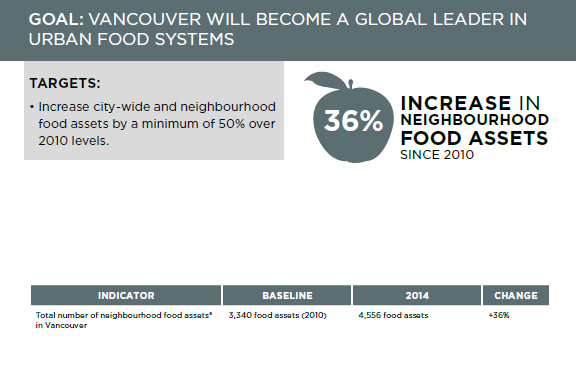
As you can see, there is definitely growth in many food assets. Is this the works of the urban growth machine or motivated individuals? I argue that it is both. People are consciously making decisions about how they want to impact the environment and the state has underlying processes that enable them to happen.
Another policy is the Vancouver Food Strategy. This was implemented in 2013 and aims to “create a just and sustainable food system for the city. It builds on years of food systems initiatives and grassroots community development, considering all aspects of the food system, from seed to table to compost heap and back again” (City of Vancouver, 2013). This is related to the local food goal in the Greenest City Action Plan which adds to the importance of this topic as considered by the state.
It should be understood that not everyone is able to participate in AFNs, although it seems to be highly encouraged by those who are involved. Is this another form of disparity between classes? How is this issue addressed? I will be posting ‘experiences and human agency’ blog posts about my experiences and observations from participating in AFNs.
Read more:
http://www.newleftproject.org/index.php/site/article_comments/a_short_history_of_neoliberalism_and_how_we_can_fix_it
http://thetyee.ca/Opinion/2014/01/29/Green-Identity-Crisis/


Comments